5 Questions: Secret Wilderness

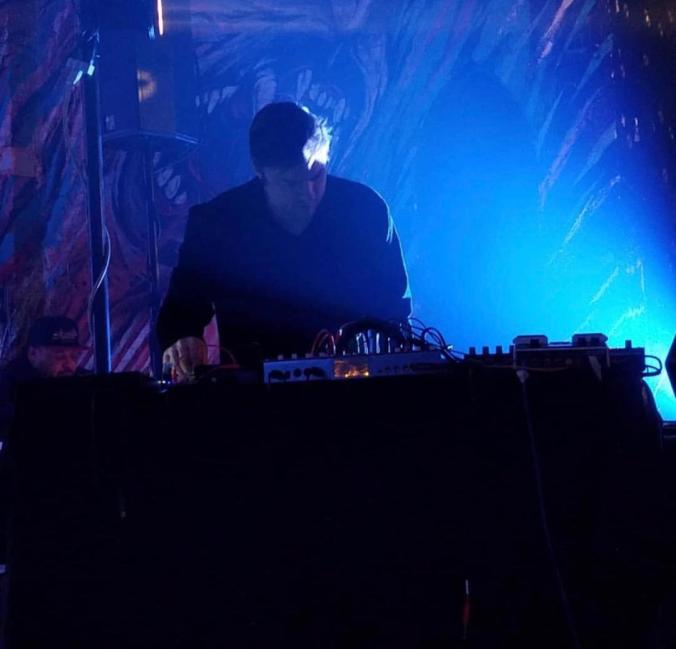
DC multi-instrumentalist and recording engineer Jake Reid is no stranger to the concept of sound as narrative. Even in the halcyon days of Alcian Blue, when Jake played feedback-drenched guitar and sang about esoteric concepts like  “Frozen Sleep” or “Terminal Escape,” it was always apparent the real story was being told not through lyrics, but through ominous clouds of billowing noise. Screen Vinyl Image married Jake’s love of blistering fuzz with John Carpenter-esque electronics and driving beats. Still, the story was the sound.
SWpic4

All this isn’t to say that the lyrics didn’t matter. It’s just that the sounds themselves – all those jaw-dropping textures of mind-melting modern psychedelia – communicated real emotion and feeling. And so it’s not surprising that Jake has become increasingly focused on building strange sonic worlds that do all the communicating for him. In recent years, Jake has honed his craft for making dark, pulsating electronic dance music under the guise Machine Drift.

A few months ago, Jake unveiled a new solo electronic project: Secret Wilderness. This latest project is the starkest signal yet of Jake’s growing comfort in harnessing sound to create incredible images and feelings in the minds and hearts of listeners.
SWpic1

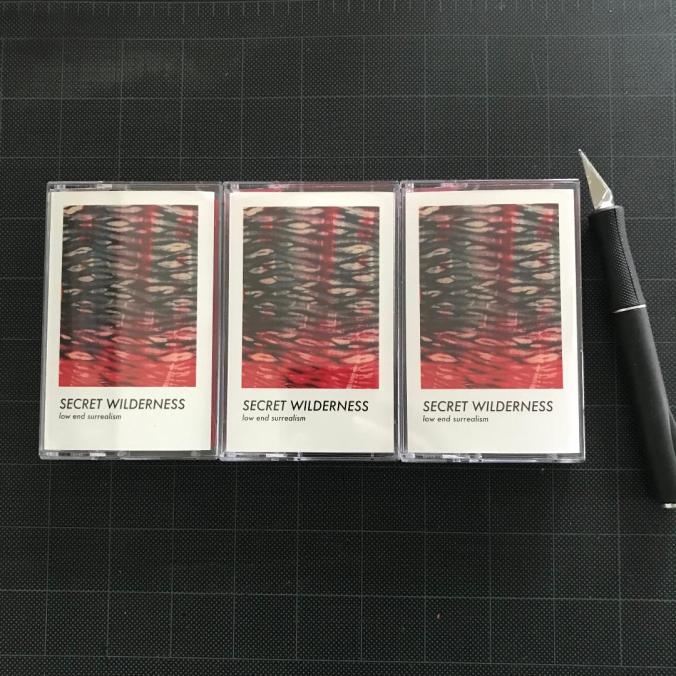
Secret Wilderness recently self-released two cassette tapes via Jake’s own Ice Station Records imprint — “Low End Surrealism” and “Secret Wilderness.” As a long-time fan of Jake’s work, it gives me great joy to say that Secret Wilderness may be his most satisfying and strange yet.
SWpic2

And this time, Jake’s work extends beyond sound. The Secret Wilderness aesthetic also encompasses featured art by Jake’s brother-in-law Justin Dodd. I asked Jake to tell me more…

1) You had been making solo electronic music as Machine Drift for several years. What was the impetus for starting Secret Wilderness?

Jake: I used Machine Drift as a name while exploring various genres in electronic music and documenting some recordings. The latest two releases I put out felt cohesive but different from the earlier stuff, it seemed like the right time to change the name.

2) The Secret Wilderness aesthetic encompasses more than just music. It’s also visual art. Can you talk a little about what led you to define Secret Wilderness beyond sound?

Jake: My brother-in-law Justin has been doing all of this great art out of NYC. Once I figured out what the new project was going to be, I wanted to have a visual aesthetic to match the music and his work was perfect. He gave me permission to use it and that’s how it came together.

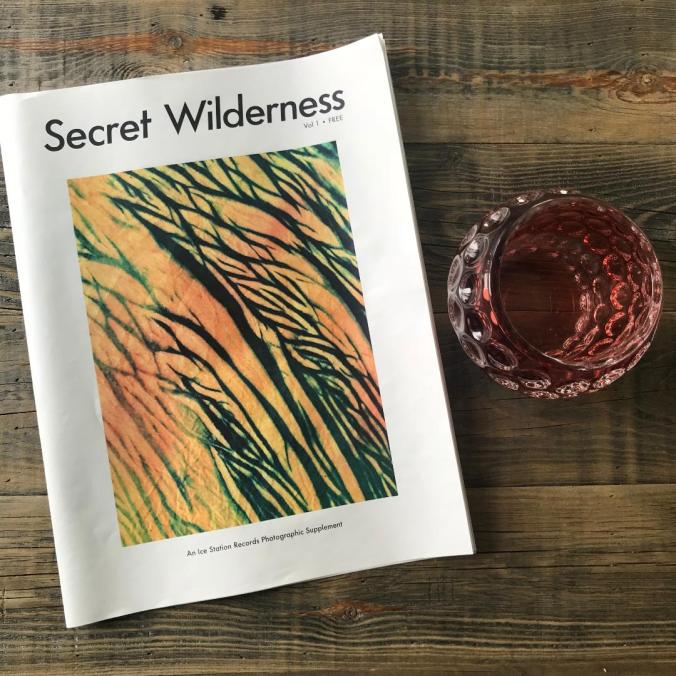
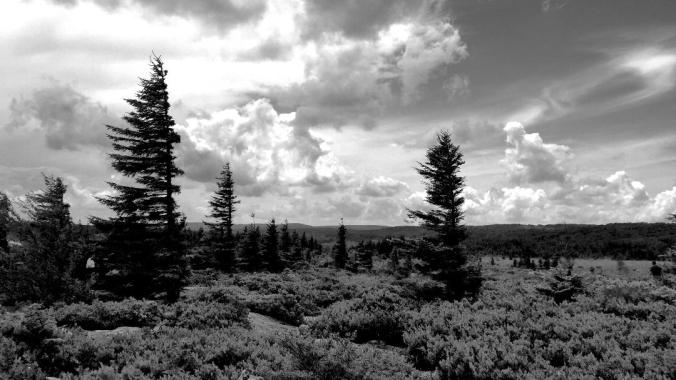
I also have a degree in design and felt a need to reconnect with it which is how the newspaper came about. It’s a collection of photos I took of places Kim and I have traveled to. I’d take these photos and memories of these places and how they made me feel back to the studio and think about them I was working. I think Monongahela is a good example of this, if you’ve ever been to that forest in WV then the music should immediately make sense and the photo I used serves as a marker for what I experienced when I was there.
SWpic3

3) The minimalist electronic sounds of “Newcomb Forest” and “Currituck” remind me a little of Brian Eno’s ambient work or Cluster. On the one hand, it’s a million miles away from Screen Vinyl Image and Machine Drift. On the other — I see a common thread. You clearly have a predilection for using sound and texture to create a hypnotic effect on the listener. Would you agree with that assessment?

Jake: Definitely. I’ve had a love of ambient music since Alcian Blue days. Texture and sound experiments have always been a big part of the type of sound I want and I like all of the different ways you can approach making this type of music.

4) To what extent has your work as a sound engineer informed what you do with Secret Wilderness?

Jake: I’ve been lucky to work with a wide range of artists for audio mastering. It’s taught me to not just pay attention to notes and frequencies but understand the vibe and how to bring that out in the music for the listener. It’s a different type of creative process and it helps me put a perspective on my own work and how I want the end piece to sound.

5) Secret Wilderness had its live debut in September. What’s it been like to take this new project out in front of a live audience?

Jake: The Machine Drift shows I did were sometimes rough but that was part of the process. I’ve now gotten to a point where I can have a structure but then plenty of room to improvise on the fly and that’s when it gets interesting. It’s still nerve-wracking though because all of your stuff is connected and needs to be working. I’m used to having Kim on stage and amps roaring so to do things by yourself is still something I’m getting used to.

Listen to and purchase “Low End Surrealism” and “Secret Wilderness” via the Secret Wilderness Bandcamp page.

Check out Secret Wilderness at WE FOUGHT THE BIG ONE on Friday, Dec. 7th!
5 Questions: Spectrums

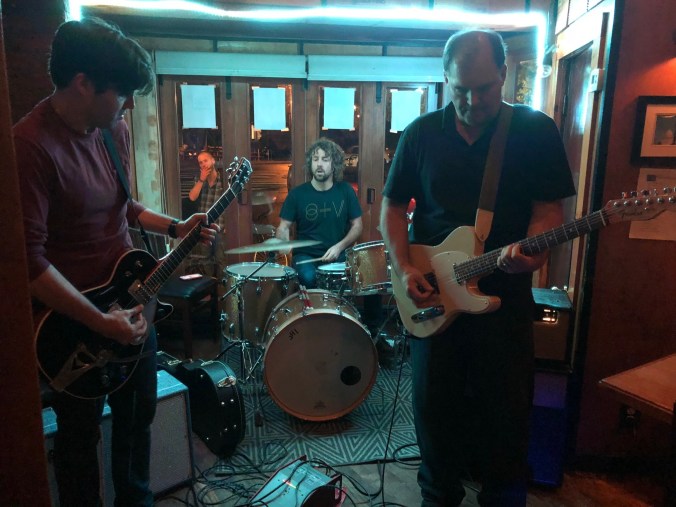
Spectrums@WFTBOAug2018DC instrumental trio Spectrums recently self-released its second EP, the aptly titled “II,” a stellar six-track collection of songs that ably demonstrates the band’s talent for building atmospheric soundscapes that are equal parts epic and intimate.
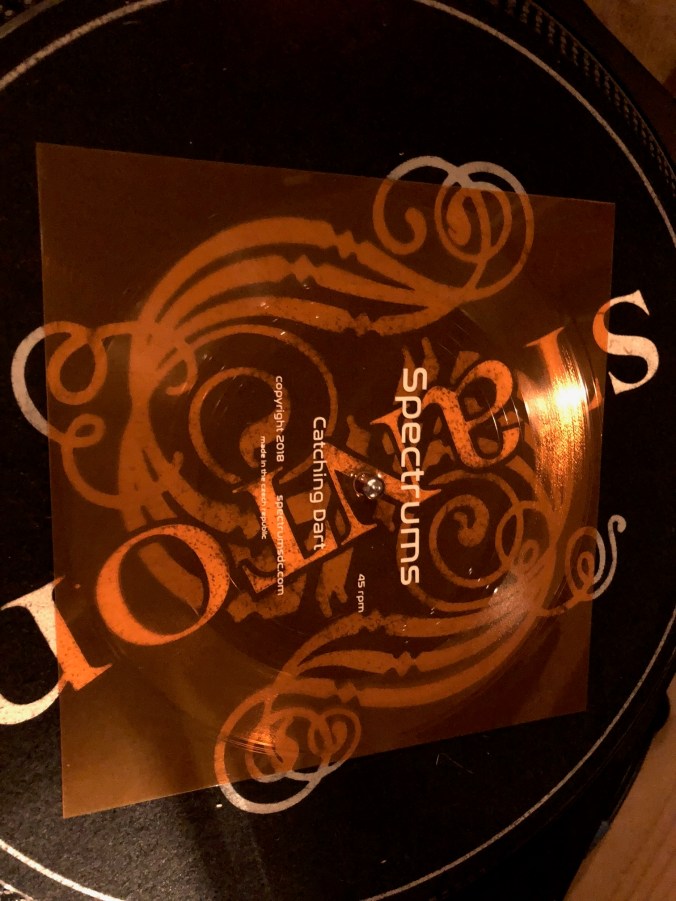
Not only is the music on the new EP uniformly excellent, the band has never sounded better from a production standpoint. Guitarists David Barker and David Nicholas, and drummer Simon Ley recorded “II” at the legendary Inner Ear Studios in Arlington, VA, home to some of the most iconic punk records of all time. They’ve also released a single, “Catching Dart,” on possibly the coolest music format of them all — the flexi!

“Catching Dart” highlights the band’s appeal — it’s a 3 minute slice of simple, melancholic guitar lines that bob and weave alongside some truly dreamlike chords, propelled by an almost jazzy uptempo rhythm. It’s calming, contemplative and otherworldly. And you’ll be humming it after only one listen.

Make no mistake. If you have a soft spot for the moodier, darker hued side of the 80s/90s UK alt scene (think The Chameleons UK, Comsat Angels and Ride), Spectrums just might be your new favorite band. If you’ve seen Spectrums live before, you know these lads have a knack for casting a spell on audiences.

Clearly, I had to get in touch with the band to delve further. Spectrums guitarist Dave Barker was only to happy to provide some answers to my questions via e-mail.

RT: First off – congratulations on the new EP. It sounds fantastic – both from a songwriting and production standpoint. What was it like to record at Inner Ear Studio, home to so many legendary DC punk recordings?

DB: More so than the Discord/punk bands, we were excited to work with Eamonn Aiken and his production skills. He gets many of the reference points we do, particularly “Starfish”-era Church and “Urban Hymns”-era Verve.

RT: Something I’ve noticed about both Spectrums EPs, but especially the latest one — these songs sound like they “belong together.” They work together as a whole as much as they do individually. I’m curious – to what extent are you thinking about the overall cohesion and feel of a release during the writing process?

DB: I think we wrote to our strengths — a blend of The Sea and Cake meets The Church if you will.

RT: Spectrums has carved out a niche in a musical space that is seldom explored by DC bands – the moodier, emotive side of the UK 80s alt scene, ala The Chameleons and Comsat Angels. I applaud the band for sticking to its creative guns and doing what it loves. What’s it been like to make music that’s a bit outside the norm for DC music, particularly as an instrumental band?

DB: I think the main thing is knowing that many of the Britpop/Brit Rock era bands have had small followings in DC. I remember seeing Starsailor play to like 50 people once and they were amazing.

Spectrums_flexi

RT: As a record geek, I am THRILLED that Spectrums released its “Catching Dart” single on a gorgeous orange flexi. Firstly, THANK YOU for doing this. The fact that “Catching Dart” may be my favorite track on the new EP makes it even better. What inspired the decision to go the flexi route with the single?

DB: Our buddy Dempsey who runs Mobius Records in Fairfax suggested flexis are the way to go.  It was pressed in the Czech Republic and they did a nice job with the transparent orange artwork. I’m proud of “Catching Dart” as a single.

RT: Having seen Spectrums live several times this year, including at WE FOUGHT THE BIG ONE, it’s evident the band line-up is really gelling. How do you feel the band dynamic is evolving in a live context? And what can you tell us about your recent and upcoming shows?

DB: More smart shows next year, and obviously returning to our favorite event We Fought the Big One.

RT: Thank you. Definitely looking forward to it!

Listen to Spectrums and buy the new EP, “II,” at their Bandcamp page.

Visit the band’s own website and “Like” them on Facebook.

Catch Spectrums on Sat. Nov. 17 at Jammin’ Java (227 Maple Ave E, Vienna, VA 22180). More show details here: Spectrums@Jammin’ Java

14 Years in 14 Songs

acoustic device ww2
Hard to imagine, but WE FOUGHT THE BIG ONE has been flying the flag of classic post-punk, mutant disco and left-of-center weirdness at the Marx Cafe (3203 Mt. Pleasant St NW, Washington DC) every first Friday night for the last 14 years. That’s quite a run. Along the way, WFTBO has become much more than a dj night to me and my WFTBO comrade and co-conspirator Brandon Grover (aka “Brando Calrissian”). Over the last 168 first Fridays, Brando and I have made many great friendships, downed countless beers and sashayed to God knows how many strange records. WFTBO became our sanctuary — the one night a month we could always count on to hang with friends, hear good music, have interesting conversations and take a breather from the mundane stresses of our daily lives. We’re so grateful to everyone who has supported us and made WFTBO what it is today — especially Marx Cafe proprietor Aris Dallas.

So to celebrate 14 years, here are 14 tracks curated by Brando and yours truly that attempt to sum up what WFTBO is all about…

Seven Songs from WFTBO DJ Brandon Grover
IMG_1625

Christof Glowalla- Erde 80 (1980)


This was a solid WFTBO favorite from the very beginning.  It was likely played at our very first night along with ending up on an early mix of ours.

Sylvia Love- Instant Love (1979)


An ecstatic bit of late disco Giorgio Moroder-ism. Sylvia gives us a science fiction love song the video for which looks like it could have taken place on Caprica.

Fox- S-S-S Single Bed (1976)


Left-field pop genius. We always strive for the songs that sound out of place out of time. S-S-S Single Bed is a synth heavy glam song with a sense of the funky pushed to another level by Noosha Fox’s iconic style and her distant and distinct vocals.

Ultravox- Frozen Ones (1977)


Off my favorite album with lyrics that are more important now than ever. John Foxx at this point was an amazing front man.

Nancy Nova- The Force (1980)


An absolutely dizzyingly complex bit of mutant disco. Gospel chorus? Check.  Bleepy electronics? Check. Spy guitar? Check. Compulsive rhythm? Check. Oddly detached jazz vocals? Yup, it’s all here.

Motorhead- Overkill (1979)


Though known for digging the crates for obscurities, WFTBO is not above rock god worship. Lemmy is more a spirit guide than anything else and so it was important to include him here. Plus this song kills.

ABBA- The Day Before You Came (1982)


See above. Lemmy was never above sharing his love of ABBA. Neither are we. This song is a masterpiece. Period.

Seven Songs from WFTBO DJ Rick Taylor…
IMG_0231

Nick Nicely – Hilly Fields (1982)


One of a kind DIY record that blends offbeat Beatles-esque psych, lo-fi electronics, some early rap-inspired record scratching, and abstract weirdness with a juggernaut of a pop hook to devastating effect. I’m still discovering Nick Nicely’s incredible back catalog, but this is my favorite track of his so far.

Furniture – Why Are We in Love (1983)


Props to Right Round DJ Erin Linkins for turning me on to Furniture, a little known British post-punk band that recorded several cool EPs and albums in the 80s. This track was recorded back in 1983 – three years before their first album – and it has an unmistakable Young Marble Giants feel, but with some wonderfully plaintive male vocals and the best use of a clarinet in a post-punk song you will ever hear. Admittedly, it is likely the ONLY use of clarinet you will ever hear in a post-punk song, but that doesn’t make it any less brilliant, does it?

Rupa – Aaj Shanibar (1982)


Rupa was a Bengali singer who sadly only made one record, but what a record it was – “Disco Jazz” in 1982. The record only exists thanks to the improbable pairing of some Canadian disco producers with Indian studio talent. When it comes to the perfect fusion dish, it’s hard to top the East meets West, guitar meets sarod, soul meets funk and psych meets disco of “Aaj Shanibar.”

Ingrid – The Jam Jar Song (1981)


The name Ingrid probably doesn’t ring a bell, but the London-based singer was a close associate of Ian Dury. This song makes me smile so much. I love the sass, the groove and the sheer sense of fun. You know you’re in for a treat as soon as you hear that four-on-the-floor groove and Ingrid coos: “I was bored with my Ford, but my sister has a Bentley, drives it very gently, makes me get loose, uses lots of juice.” Finding an obscure gem like this is why Brandon and I spend so much time and energy (not to mention cold hard cash) turning over every potentially oddball DIY rock we can find!

Yello — Cuad El Habib (1981)


A stunning slice of moody, mind-bendingly creative, Dada-esque minimal synth from yes, you guessed it – the same Swiss duo that brought us THAT Ferris Bueller song. How is it possible this could be recorded by the same group? “Anyone? Anyone?”

Arthur Russell — This Is How We Walk on the Moon (1994)


Arthur Russell was a genius and this is pretty much the greatest song I’ve ever heard in my entire life. There. I’ll leave it at that.

Virna Lindt — Underwater Boy (1984)


One music critic referred to the music that Virna Lindt made as “John Barry meets new wave,” but that doesn’t quite capture it. “Underwater Boy” is a fractured slide of melancholic non-disco, with a tinge of restless gloom. It’s the kind of late night left-field gem that perfectly sums up what We Fought the Big One has been about for the last 14 years.

Wait – the Big One Blog?

Yes. DC’s monthly celebration of post-punk classics, John Peel faves and left-of-center gems — otherwise known as We Fought the Big One — now has a blog. Why? Well, we thought it might be fun to have a place online where we could gab about records. Talk about bands. Post setlists. Link to some tunes. You get the idea. It’s really about expanding the experience of We Fought the Big One beyond the confines at the Marx Cafe. Or something like that. So watch this space. We’ve got big things planned. After all, it’s the Big One Blog!